
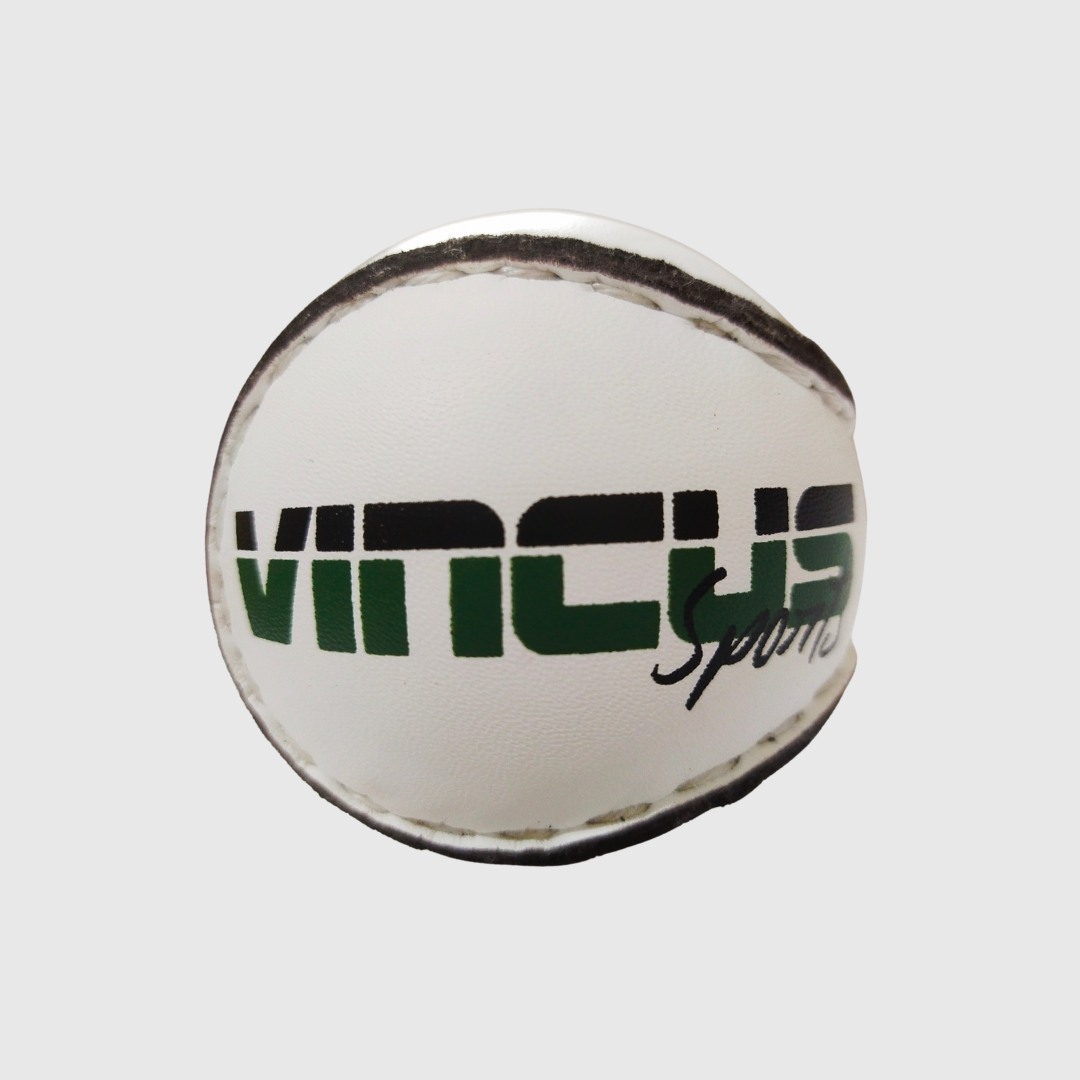
A sliotar looks simple: a small ball with a raised seam. Yet every one that leaves a factory has passed through a series of careful steps, most of them done by hand. For clubs, retailers and brands buying sliotars in volume, understanding how sliotars are made helps you ask better questions, judge samples more confidently and spot quality issues before they reach your customers.
What Goes Into a Sliotar
Before looking at the process, it helps to know the parts. A sliotar has three main elements:
- A core, which gives the ball its weight, bounce and feel off the hurley
- A cover, made from two stitched panels
- A raised rib, formed where the two panels are stitched together around the ball
The finished full-size ball has to meet tight limits set out in the sport’s Official Guide: a diameter of 69mm to 72mm (not counting the rib), a mass of 110g to 116g, a rib height of 1.8mm to 2.6mm, a rib width of 3.6mm to 5.4mm, and a cover thickness of 1.8mm to 2.7mm with any laminated coating no thicker than 0.15mm. Every production step is aimed at landing inside those numbers, ball after ball.
Stage One: Building the Core
The High-Quality PU Core
Every Vincus sliotar is built around a high-quality polyurethane (PU) core, from our match-grade balls to our training ranges. A PU core is moulded as a single, uniform piece under heat and pressure, which makes it far easier to repeat the same weight and balance across a production run. Its closed-cell structure resists water, so the ball keeps its weight and behaviour in the rain, and it holds its shape under heavy use. That consistency is why the high-quality PU core is the standard at the top level of the game.
Why the Winding or Bonding Matters
Around the core, winding or bonding fixes its shape and spreads the mass evenly. Tension is the skill here. Too loose, and the ball can lose shape under repeated impact. Too tight, and it becomes overly hard. Getting this right is what gives the finished ball a true flight.
Stage Two: Preparing the Cover
Material Choice
The choice of cover material affects how the ball feels and how it behaves in different conditions. A less porous cover holds its weight better in wet conditions and are made to an even thickness, which avoids the natural variation found across a hide.
Lamination
Synthetic cover material is typically bonded to a fabric backing before it is cut. This backing gives the panel strength, so it holds its shape under stitching tension and repeated strikes. Poor lamination can show up later as bubbling or peeling, which is why it is checked closely.
Cutting the Panels
Each sliotar cover uses two matching panels. They are cut precisely, because any variation in shape or size shows up in the final diameter, the evenness of the rib and the weight of the ball.
Stage Three: Hand-Stitching the Rib
This is the stage that defines a sliotar. The two panels are placed around the core and stitched together by hand, forming the raised rib that runs around the ball. A single ball can take close to an hour of skilled work.
The stitcher has to keep tension even all the way round, so the rib stays a consistent height and width and the cover sits tightly on the core. Uneven tension leads to a lumpy rib, loose patches or a ball that wobbles in flight. The rib also gives players something to grip when they lift and catch, so its finish directly affects how the ball plays.
Stage Four: Finishing and Checking
Once stitched, each ball is finished and inspected. Typical checks include:
- Weight, to confirm it falls within the permitted range
- Diameter, measured without the rib
- Rib height and width
- Visual inspection of stitching, cover surface and shape
- Performance checks, such as how the ball rebounds
Balls used in official matches must be approved and carry the mark of approval, so buyers should always ask suppliers about the approval status of the exact ball they are ordering.
Why Sialkot Makes So Many Sliotars
Sialkot in Pakistan has made sports goods for well over a century and is known around the world for hand-stitched balls. Because each sliotar involves so much skilled hand work, production has naturally gathered where that skill runs deepest. Generations of stitchers in Sialkot have built up the experience needed to keep tension even and ribs consistent across large orders.
Vincus Sports is a Sialkot-based manufacturer and exporter of sliotars, alongside speed and wall balls, hurling gloves and hurley bags. We supply clubs, wholesalers and brands in Ireland, the UK, the USA and Europe, including OEM and private label orders.
Browse our sliotars or explore our wider hurling range, including hurling gloves.
What This Means for Buyers
Knowing how sliotars are made gives you a practical checklist for samples:
- Confirm the ball has a high-quality PU core and check that its weight and bounce are consistent across samples.
- Check the cover material and look for smooth, bubble-free lamination.
- Run your fingers around the rib to feel for even height and tight stitching.
- Weigh and measure a few balls against the official limits.
- Confirm approval status for any ball sold for match use.
Request a Quote for Sliotars
Whether you need match balls, training balls or a private label range, we can help. Tell us the sizes, quantities and branding you need and our team will come back with options. We offer 24/7 support via WhatsApp, or you can contact Vincus Sports for a quote.
Leave a Reply