
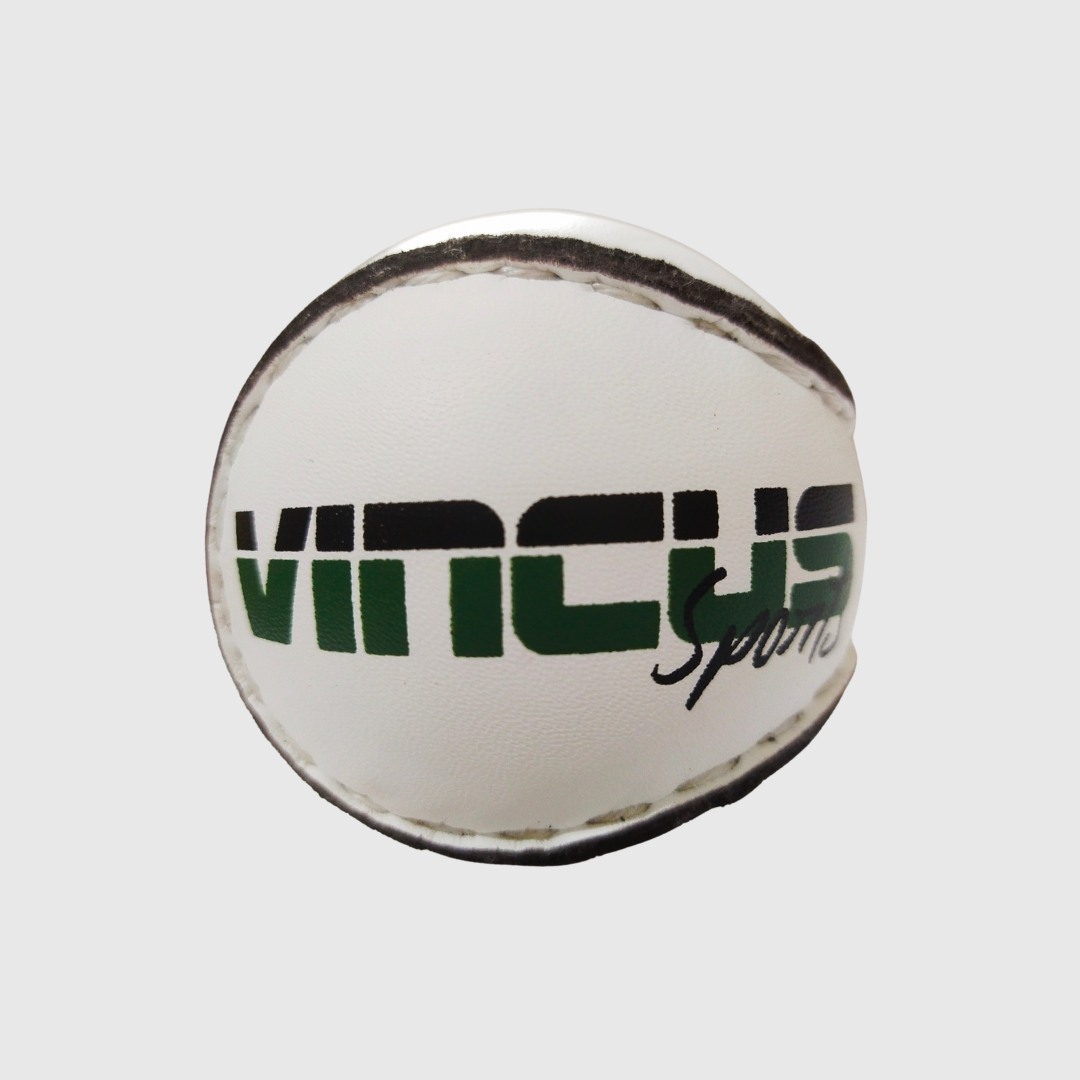
If you buy sliotars in volume for a club, a wholesale range or your own brand, the core is the part of the ball that matters most and the part you can’t see. Two balls can look the same on a shelf, yet play very differently once they’ve been struck a few hundred times or carried through a wet evening session. This guide compares the two core types you’ll meet when sourcing, polyurethane (PU) and cork, and explains why every Vincus sliotar is built around a high-quality PU core.
What the core actually does
A sliotar is not a solid ball of one material. It’s a core with a stitched cover and raised rim. The core sets most of the ball’s weight, how it rebounds off the hurl and the ground, and how it feels on the hand. The cover and rim mostly affect grip and handling.
Since the core drives performance, it’s the first thing to ask a supplier about. If you’d like the full build process from start to finish, see our guide on how sliotars are made.
The two core types
Cork core
The traditional construction starts with a cork centre that is wound tightly in layers of yarn to bring it up to the right size and weight before the cover goes on. Much of this winding is done by hand, so the finished core depends on the skill and care of whoever wound it. Cork cores are still around, and some makers of cheap sliotars use them because they keep costs down.
PU core
A PU core is made in a different way altogether. Polyurethane is foam-moulded into a single, uniform sphere. The material’s density can be controlled during manufacture, and every core comes out of the same mould. There are no separate wound layers to shift or loosen.
The sport itself has moved this way. Researchers at Dublin City University note that sliotars used in hurling have moved away from cork and mixed cores towards cores made entirely of polyurethane, and that the official Smart Sliotar introduced in 2024 uses a foam-moulded polyurethane core with an embedded chip.
PU core vs cork core: the four tests that matter
1. Consistency
For a buyer, consistency is the big one. A club wants every ball in the bag to behave the same, and a brand wants every carton to match the last one.
- Cork: Because the core is built up from cork and hand-wound yarn, results can vary from batch to batch and from one maker to another.
- PU: Moulding produces a uniform core, and the process can be controlled closely. That’s why a well-made PU core gives a more repeatable ball.
An honest caveat: one DCU study found variation within a polyurethane ball type that it linked to differences in sample mass, and it said that variation should be avoidable because the material and process can be tightly controlled. In other words, PU only delivers consistency when the factory controls its moulding properly. That’s why the quality of the PU matters, not just the label.
2. Bounce
The rebound of a sliotar is measured with a drop test, and both core types can be made to fall inside the same rebound window. The difference shows up at speed. DCU research found that traditional cork-and-yarn balls behave in a more non-linear way under impact, because the yarn compresses first and the cork engages only as the ball squashes further. At higher impact speeds, their performance diverged from modern balls. The researchers also pointed out that standard low-speed drop testing doesn’t reveal this.
Moulded PU cores behaved in a more linear, predictable way as impact speed rose. For players, that means a ball that reacts the same way to a soft touch and to a full-blooded strike.
3. Durability and weather
Weather matters in hurling and camogie, as so much of the season is played in the rain.
- Cork: Cork and yarn absorb water. A cork-cored ball gets heavier as a wet match or session goes on, and it travels less far and feels deader. As far back as 1998, academic research on hurling equipment measured water absorption in sliotars and their cork and yarn components for exactly this reason.
- PU: A closed-cell PU core resists moisture, so it keeps its weight and liveliness much better through a wet session.
For training stock, there’s another point. Repeated hard strikes can compress cork for good, and the yarn winding can shift over time. PU stands up better to repeated high-speed impacts, which matters when a single ball is struck again and again in drills.
4. Holding shape
A sliotar that goes slightly out of round won’t fly or bounce true. With cork cores, the risk comes from the wound construction: layers of yarn can move after heavy use, leaving the core a little uneven. A PU core is one moulded piece, so there are no internal layers to slip, and it holds its round shape well over a long working life.
At a glance
| What buyers check | Cork core | PU core |
|---|---|---|
| Construction | Cork centre wound with yarn, largely by hand | Single foam-moulded polyurethane sphere |
| Consistency | Can vary between batches and makers | Uniform when moulding is well controlled |
| Bounce at speed | More non-linear as impact increases | More linear and predictable |
| Wet weather | Absorbs water, gets heavier and deader | Resists moisture, keeps its playing weight |
| Durability | Cork can compress, yarn can shift | Stands up better to repeated hard strikes |
| Holding shape | Wound layers can move with heavy use | One-piece core with no layers to slip |
Why Vincus uses PU cores only
We make sliotars for clubs, wholesalers and brands across Ireland, the UK, the USA, Europe and Australia. Those buyers need balls that play the same in every carton and keep playing well through a long, wet season. That’s why every Vincus sliotar uses a high-quality PU core. We never use cork.
Cork cuts costs for some low-cost makers, but the savings show up later as balls that soak up water, vary from one to the next and wear out faster in training. For a club treasurer or a brand owner, replacing balls early and fielding complaints costs far more than getting the core right in the first place.
What to ask any sliotar supplier
Before you place a bulk order, ask:
- What is the core made of? Get a clear answer: PU or cork.
- How is the core made? Moulded PU should come from a controlled process, not loose tolerances.
- Which sizes do you supply? Size 5 is the hurling ball and size 4 is the camogie ball. Our guide to sliotar sizes explained covers the full range.
- Can I see samples first? Strike them, bounce them and leave one out in the rain before you commit.
You can browse our range of sliotars to see what we make for club, Gaelic and brand programmes.
Request a quote
Sourcing PU core sliotars for your club, shop or own brand? Email qasim@vincussports.com with the sizes, quantities and any branding you need, and we’ll get back to you with a tailored quote.
Leave a Reply